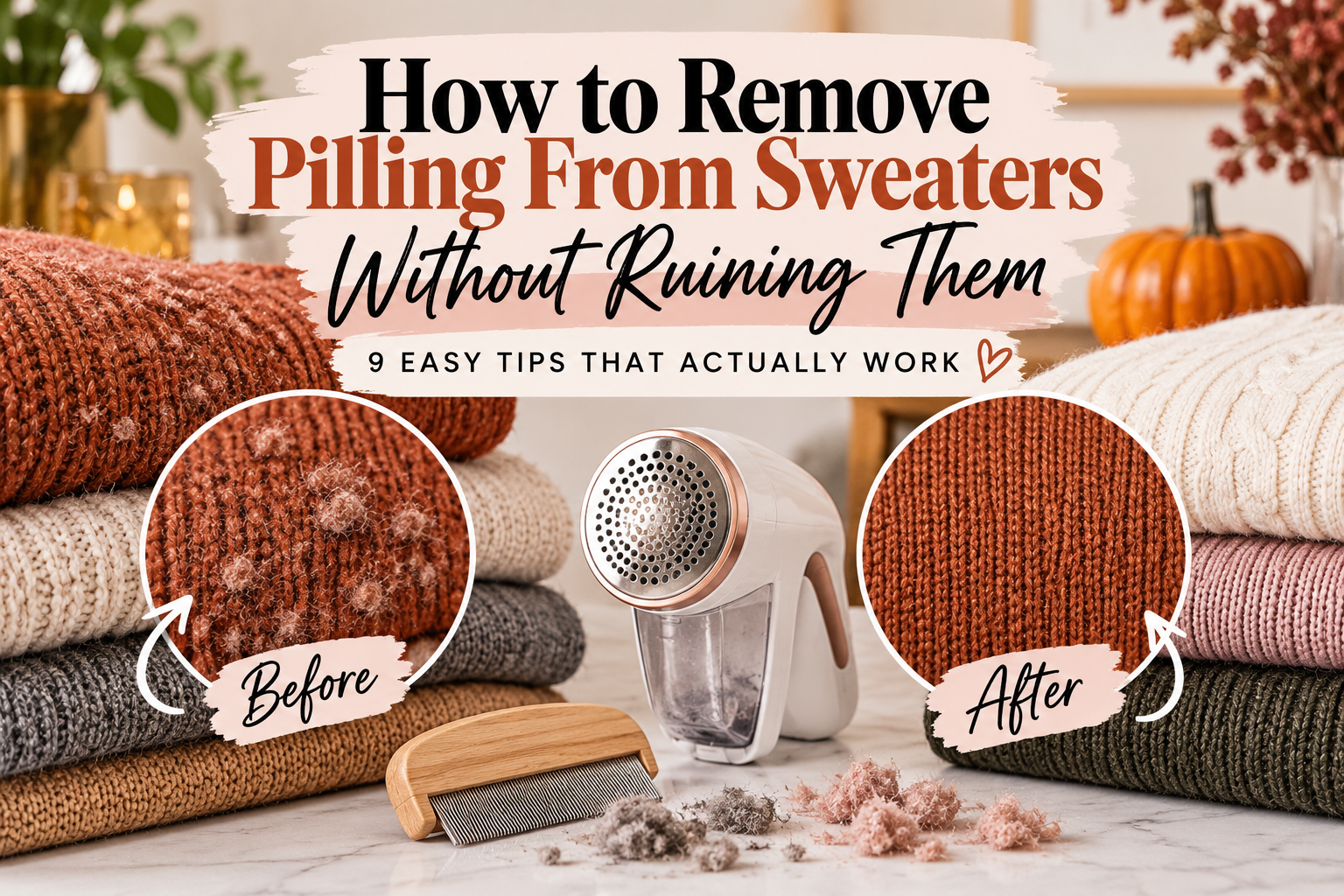

You know that gorgeous sweater you bought last fall? The one that was soft, cozy, and made you feel like you had your entire life together?
Now it looks like it’s been through a washing machine with a family of raccoons.
Those annoying little fuzz balls covering your favorite sweater are called pills, and they’re one of the fastest ways to make perfectly good clothing look old and worn out.
But here’s the good news: You don’t have to throw away a sweater just because it’s covered in pilling.
As someone who’s spent nearly two decades buying, selling, and inspecting secondhand clothing, I’ve seen plenty of sweaters that looked ready for retirement but just needed a little attention.
The secret is knowing how to remove sweater pilling without damaging the fabric.
Because there’s a very fine line between restoring your favorite cashmere sweater and accidentally giving it a bald spot.
Let’s make sure you stay on the right side of that line.
1. First, Understand Why Sweaters Pill in the First Place
Before you start attacking your sweater with whatever sharp object you find in the bathroom drawer, it helps to understand what’s happening.
Pilling occurs when loose or broken fibers become tangled together on the surface of fabric, creating those tiny, annoying balls.
Friction is usually the culprit.
Think about all the places your sweater rubs against things throughout the day:
- Under your arms
- Along the sides of your body
- Around the cuffs
- Where your purse strap sits
- Anywhere your seat belt rubs
Some fabrics are more prone to pilling than others.
Wool, cashmere, acrylic, polyester blends, and other knits can all develop pills. Shorter fibers and loosely spun yarns may be especially susceptible, although fiber quality, yarn construction, and fabric structure also matter.
And here’s something people don’t realize:
Pilling doesn’t automatically mean a sweater is cheap or poor quality.
Even expensive cashmere sweaters can pill.
Yes, your $200 sweater can develop the same annoying fuzz balls as the one you found for $6 at Goodwill.
Fashion really does keep us humble.
2. Use a Fabric Shaver for Fast Sweater Pilling Removal
If you’ve ever wondered what the easiest way to remove pilling from sweaters is, a fabric shaver is often the answer.
These little devices are essentially tiny lawnmowers for your clothing.
And watching them work is ridiculously satisfying.
A fabric shaver uses rotating blades behind a protective screen to trim pills from the surface of your sweater.
How to use a fabric shaver safely
- Lay your sweater completely flat on a clean, firm surface.
- Smooth out any wrinkles or folds.
- Test the shaver on a small, hidden area first.
- Turn it on and gently move it across the fabric.
- Use light pressure and short, controlled movements.
- Stop frequently to inspect the fabric.
Important: Never press hard or repeatedly shave the same area trying to make it perfectly smooth.
You can accidentally cut healthy fibers, thin the knit, or create a hole.
Fabric shavers generally work best on relatively sturdy, smooth knits. Use extra caution with delicate cashmere, loose knits, embroidery, and textured sweaters.
And please don’t use one over a raised seam.
Your sweater deserves better.
3. Try a Sweater Comb for Delicate Fabrics
If the idea of bringing spinning blades anywhere near your favorite cashmere sweater makes you nervous, consider a sweater comb.
Sweater combs are manual tools designed to lift and remove surface pills.
Some have fine metal screens, while others have textured or comb-like edges.
They’re particularly useful when you want more control over the process.
How to remove pilling with a sweater comb
- Lay your sweater flat.
- Hold the fabric gently but firmly.
- Test the comb on an inconspicuous area.
- Move it lightly across the surface in short strokes.
- Remove collected fibers as you work.
Avoid pulling or dragging the comb aggressively across the knit.
Not every sweater comb is suitable for every fabric, so check the manufacturer’s recommendations before using one on delicate cashmere or fine wool.
My tip: If you’re working with an expensive sweater, start with the gentlest method possible.
You can always remove more pills.
You cannot put a snagged yarn back together quite so easily.
4. Remove Individual Pills by Hand
Sometimes the best sweater-saving tool is already attached to your body.
Your fingers.
If your sweater only has a few visible pills, you may not need a fabric shaver or sweater comb at all.
Gently lift the pill and trim it with small, sharp scissors, taking care not to cut the underlying knit.
Do not yank or pull the pill off.
Pulling can stretch or break additional fibers and make the problem worse.
This method works particularly well for isolated pills on delicate sweaters where using a larger tool would be unnecessary.
Is it exciting?
No.
But neither is accidentally cutting a hole in your favorite sweater because you got a little too enthusiastic with a fabric shaver.
5. Be Careful With the Disposable Razor Trick
You’ve probably seen this trick online.
Someone takes a disposable razor, runs it across a sweater, and suddenly the fabric looks brand new.
Very satisfying.
Also potentially disastrous.
A regular razor blade doesn’t have the same protective guard as a dedicated fabric shaver.
That means it’s easier to slice into the actual fabric, especially if the sweater has raised stitches, uneven texture, or loose yarns.
Could it remove pills?
Yes.
Would I recommend it for cashmere, wool, or an expensive sweater?
Absolutely not.
A proper fabric shaver or sweater comb is generally a much safer choice.
There are plenty of ways to save money on clothing.
Accidentally turning a $150 sweater into a crop top shouldn’t be one of them.
6. Never Use a Fabric Shaver on These Sweater Details
Not every sweater is a good candidate for shaving.
Before you start, inspect the fabric carefully.
Avoid using a fabric shaver directly over:
- Loose or chunky knit stitches
- Open-knit or crochet sections
- Embroidery
- Sequins or beads
- Decorative yarn loops
- Snags or pulled threads
- Areas that are already visibly thin
These details can catch in the shaver and cause permanent damage.
If a sweater has a delicate or unusual texture, manual removal of individual pills may be safer.
And if you’re unsure whether the fabric can handle it?
Leave it alone until you can identify a suitable cleaning or repair method.
A few fuzz balls are better than a hole.
Every single time.
7. Know When a Pilled Sweater Isn’t Worth Saving
Here’s where my reseller experience comes in.
Not every sweater deserves a rescue mission.
Sometimes the pilling is minor, and removing it makes the sweater look dramatically better.
Other times, the fabric itself is simply worn out.
Signs your sweater is worth saving
- Pilling is mostly on the surface.
- The fabric underneath is still thick and intact.
- There are no major holes or snags.
- The sweater still holds its shape.
- The pills are concentrated in a few areas.
Signs it’s time to reconsider
- The knit is noticeably thin or transparent.
- There are holes forming around high-friction areas.
- The fabric looks matted or heavily abraded.
- The sweater has stretched permanently out of shape.
- Removing the pills would require shaving large amounts of material away.
Here’s the important distinction:
Removing pilling improves a sweater’s appearance, but it doesn’t reverse actual fabric wear.
If the fibers underneath are already damaged, shaving off the pills won’t restore them.
In fact, aggressive depilling can make a worn sweater even thinner.
Sometimes the smartest thing you can do is stop.
8. Prevent Sweater Pilling Before It Starts
Now that you’ve rescued your sweater, let’s try to keep it looking good.
You can’t prevent all pilling, but you can reduce the friction and abrasion that contribute to it.
Wash sweaters gently
Always follow the garment’s care label.
For machine-washable sweaters, consider turning them inside out and using a mesh laundry bag on a gentle cycle.
For sweaters labeled hand-wash only, follow those instructions.
And if the tag says dry clean only, don’t assume a quick spin in the washing machine will be fine.
That’s how innocent sweaters become doll clothes.
Avoid overcrowding the washing machine
Clothes rubbing against one another can increase surface wear.
Give your sweaters some breathing room.
Reduce friction
Heavy shoulder bags, rough jackets, and constant rubbing can contribute to pilling.
You don’t have to redesign your entire life around protecting a sweater, but it’s worth being aware of repeated friction.
Dry sweaters properly
If the care label calls for flat drying, reshape the sweater and lay it flat on a suitable drying surface.
Avoid unnecessary tumble drying, which can increase abrasion and may damage certain fibers.
Store sweaters folded
Heavy sweaters can stretch when left hanging for long periods.
Folding helps preserve their shape.
And no, shoving them into an overflowing drawer and hoping for the best does not count as proper storage.
9. Choose Sweaters That Are Less Likely to Pill
If you’re tired of constantly removing fuzz balls, pay attention to fabric construction when shopping.
This is especially useful when buying secondhand sweaters.
Look closely at the knit.
Does the surface already have lots of loose fibers?
Does the fabric feel unusually fuzzy or loosely constructed?
Are there pills forming around the underarms or sides?
These can be clues about how the sweater wears over time.
Generally, tightly spun yarns and more stable fabric constructions may resist pilling better than loose, fuzzy knits.
But don’t assume that natural fibers never pill or that synthetic fabrics always do.
Both can pill, and the exact behavior depends on the yarn and construction.
My favorite secondhand shopping trick?
Inspect the areas where pilling normally develops.
A used sweater that’s still smooth under the arms and along the sides may give you a better idea of how it’s holding up than one that looks beautiful only on the front.
That’s one advantage of buying secondhand.
Sometimes the clothing has already passed its first real-world durability test.
Fabric Shaver vs. Sweater Comb: Which Is Better?
Still not sure which tool to use?
Here’s the easiest way to decide.
Choose a fabric shaver if you’re dealing with widespread pilling on a sturdy, relatively smooth sweater. It’s usually the fastest option, but it requires a gentle touch to avoid thinning or cutting the fabric.
Choose a sweater comb if you want more control when removing pills from a compatible knit. Make sure the comb is appropriate for the fabric, especially when dealing with cashmere or fine wool.
Choose small scissors if there are only a handful of individual pills. Carefully trimming them can be safer than treating an entire area unnecessarily.
Skip the disposable razor, particularly on expensive or delicate sweaters. The risk of accidentally slicing into the knit simply isn’t worth it.
Whatever method you choose, always test a small, hidden section first.
Your goal is to remove the pills, not half the sweater.
Frequently Asked Questions About Sweater Pilling
Can you completely remove pilling from a sweater?
You can often remove most visible surface pills, but complete removal isn’t always possible without damaging the fabric. Some pilling may also return with continued wear.
Does removing pilling damage sweaters?
It can if you use too much pressure, an unsuitable tool, or repeatedly shave the same area. Gentle removal with the appropriate tool reduces the risk.
Can you use a fabric shaver on cashmere?
Some cashmere sweaters can be carefully depilled using tools specifically recommended for cashmere. However, fine or delicate cashmere can be damaged easily. Always check the garment and tool instructions and test an inconspicuous area first.
Does washing remove sweater pilling?
Washing generally won’t remove established pills reliably. In some cases, agitation can make pilling worse. Use a suitable depilling method instead.
Why does my expensive sweater pill?
Price doesn’t guarantee resistance to pilling. Fiber length, yarn twist, knit construction, and friction all influence how much a sweater pills.
How often should you remove pilling?
Only when needed. Excessive depilling can gradually remove fibers and shorten the life of a garment.
Final Thoughts: Don’t Give Up on Your Favorite Sweater Yet
A pilled sweater isn’t necessarily a ruined sweater.
Sometimes all it needs is a few minutes with the right tool and a little patience.
The key is understanding the difference between harmless surface pilling and actual fabric damage.
Because removing fuzz balls is one thing.
Removing half the sweater in the process is another.
And before you toss that old sweater or replace it with something new, remember that a little clothing maintenance can save money, reduce waste, and keep your favorite pieces in rotation longer.
That’s something I’ve learned from years of buying and selling secondhand fashion: Sometimes the best clothing find is the piece you already own.
Looking for more unique secondhand fashion finds? Visit Premier Finds on eBay and discover clothing worth giving a second life.
Happy sweater saving! 🧶



Leave a Reply