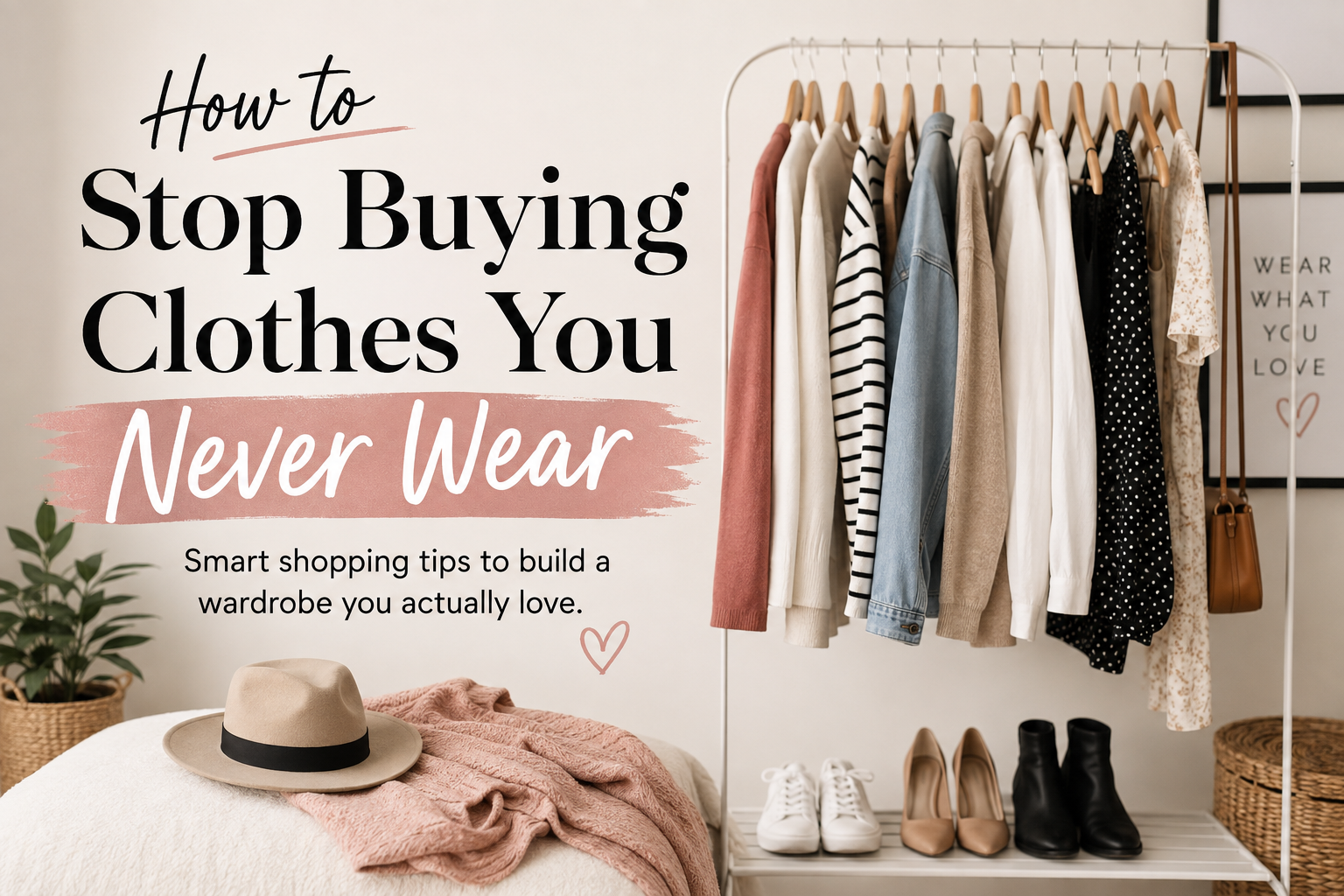

You know the piece.
It looked incredible on the hanger. You pictured the outfit. Maybe you even imagined where you’d wear it. You brought it home, hung it in your closet…and there it stayed.
Six months later, the tags might still be attached.
If your closet is full but you constantly feel like you have nothing to wear, the problem probably isn’t that you need more clothes. It may be that you’re buying clothes for the wrong reasons.
Here’s how to break the cycle and start building a wardrobe you actually wear.
1. Stop Shopping for Your Fantasy Self
This might be the biggest reason we buy clothes that never leave the closet.
We don’t always shop for the life we actually live. We shop for the life we imagine ourselves living.
You buy the gorgeous blazer because Fantasy You attends sophisticated dinners every weekend.
You buy five workout sets because Fantasy You is about to become a 6 a.m. Pilates person.
You buy uncomfortable heels because Fantasy You apparently never has to walk farther than 20 feet.
Meanwhile, Actual You reaches for jeans, sneakers and the same three comfortable tops.
There’s nothing wrong with experimenting with your style. But before buying something, ask yourself:
“Where would I realistically wear this in the next 30 days?”
If you can’t think of an answer, that’s useful information.
2. Pay Attention to What You Already Wear
Your laundry basket may know your personal style better than your Pinterest board does.
Look at the clothes you wear repeatedly.
What fabrics are they?
What silhouettes?
What colors?
Are they fitted or oversized? Structured or soft? Neutral or colorful?
Those patterns tell you much more about your real preferences than whatever aesthetic is currently taking over TikTok.
If you own 15 structured button-down shirts but repeatedly wear soft knit tops, you probably don’t need another button-down—even if it’s beautiful.
Shop according to your behavior, not your aspirations.
3. Don’t Buy Something Just Because It’s a Great Deal
This one is especially dangerous for bargain hunters.
Finding a $200 dress for $20 feels like winning.
But if you never wear it, you didn’t save $180.
You spent $20.
A discount can make an item feel more valuable than it actually is to you. The question isn’t simply, “Is this worth more than they’re charging?”
It’s:
“Is this worth buying for me?”
Those are two very different questions.
4. Use the Three-Outfit Rule
Before buying a piece of clothing, mentally create three outfits using things you already own.
Not things you’re planning to buy.
Not the perfect boots you might eventually find.
Not the imaginary jacket that would make the entire outfit work.
Clothes already sitting in your closet.
If you can immediately picture three outfits, the item has a much better chance of becoming part of your actual wardrobe.
If buying one shirt suddenly requires buying pants, shoes and a jacket to make it work, that “great deal” is getting expensive quickly.
5. Stop Ignoring Fabric
Sometimes we love the way something looks but hate the way it feels.
And comfort usually wins eventually.
If polyester makes you hot, stop convincing yourself that this polyester dress will somehow be different.
If you hate ironing, that gorgeous linen piece may spend more time wrinkled in the laundry pile than on your body.
If itchy wool drives you crazy, the fact that a sweater is beautiful isn’t going to make it less itchy.
Read fabric labels and learn which materials you genuinely enjoy wearing.
Your closet should work with your preferences—not require you to overcome them.
6. Know Your Deal Breakers
Everyone has them.
Maybe you hate strapless bras.
Maybe you won’t wear anything that needs dry cleaning.
Maybe dresses without pockets annoy you.
Maybe low-rise jeans are never, ever happening again.
Make a mental list of your clothing deal breakers and actually listen to it while shopping.
We waste a surprising amount of money buying clothes that contain features we already know we dislike.
7. Be Careful With Trends
Trends are fun. They can make fashion feel fresh and give us new ways to experiment.
But liking something on someone else doesn’t necessarily mean you’ll like wearing it yourself.
Before buying a trending piece, ask:
“Would I still want this if I hadn’t seen it 47 times on social media this week?”
Sometimes the answer will absolutely be yes.
Other times you’ll realize repetition has convinced you that you like something more than you actually do.
8. Measure Clothes You Already Love
This is especially important when shopping online or buying secondhand.
Sizing is wildly inconsistent between brands—and sometimes even between different styles from the same brand.
Instead of relying exclusively on the size printed on the tag, measure a few pieces you already own and love.
For tops and dresses, knowing measurements such as pit-to-pit and length can be incredibly helpful.
For pants and jeans, know your preferred waist, rise and inseam.
Then compare those measurements with the item you’re considering.
A tag might tell you what size a garment is supposed to be.
Measurements tell you whether it might actually fit you.
9. Give Yourself a Waiting Period
Impulse purchases thrive on urgency.
Only two left!
Sale ends tonight!
Everyone is wearing it!
Try waiting 24 to 48 hours before purchasing something you weren’t specifically looking for.
If you’re still thinking about it tomorrow, reconsider it.
You may be surprised how often the obsession disappears once the initial dopamine hit wears off.
10. Ask the Most Important Question
Before you buy anything, ask yourself:
“Would I want to wear this tomorrow?”
Not someday.
Not after you lose five pounds.
Not on a hypothetical vacation.
Not when you finally get invited to an event requiring a floor-length sequined gown.
Tomorrow.
That question forces you to think about your actual life, actual body and actual wardrobe.
And that’s ultimately the goal.
Your Closet Doesn’t Need to Be Bigger. It Needs to Be Better.
A great wardrobe isn’t necessarily one with hundreds of options.
It’s one where you open the closet and genuinely want to wear what’s inside.
Buying secondhand can make that easier because you aren’t limited to whatever retailers have decided is trendy this season. You can search across brands, decades, fabrics, silhouettes and styles to find pieces that actually feel like you.
But whether you’re shopping secondhand or buying something brand new, the same rule applies:
Buy for the person you are and the life you actually live.
Because the best deal isn’t the designer dress you scored for 90% off.
It’s the piece you wear so often that you eventually lose count.



Leave a Reply